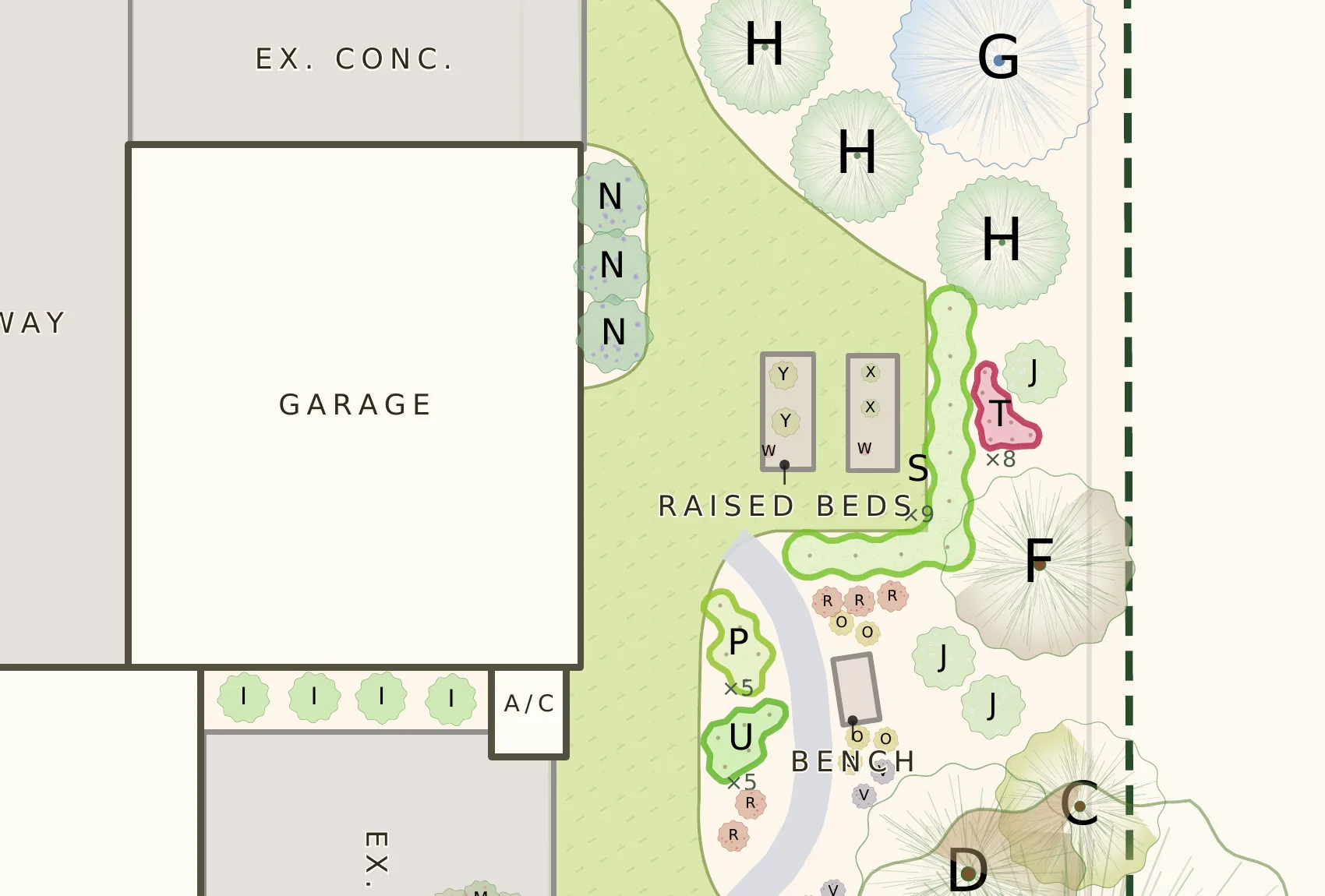
This design started as pencil on paper. The original was a hand-drawn backyard master plan, the kind a landscape designer letters by hand, with notes like "EX. GATE" and "RAISED BEDS" scattered across it. We rebuilt it in Plantyd to see how a paper plan holds up as a working digital one. The answer: very well, and now the homeowner can move a tree without an eraser.
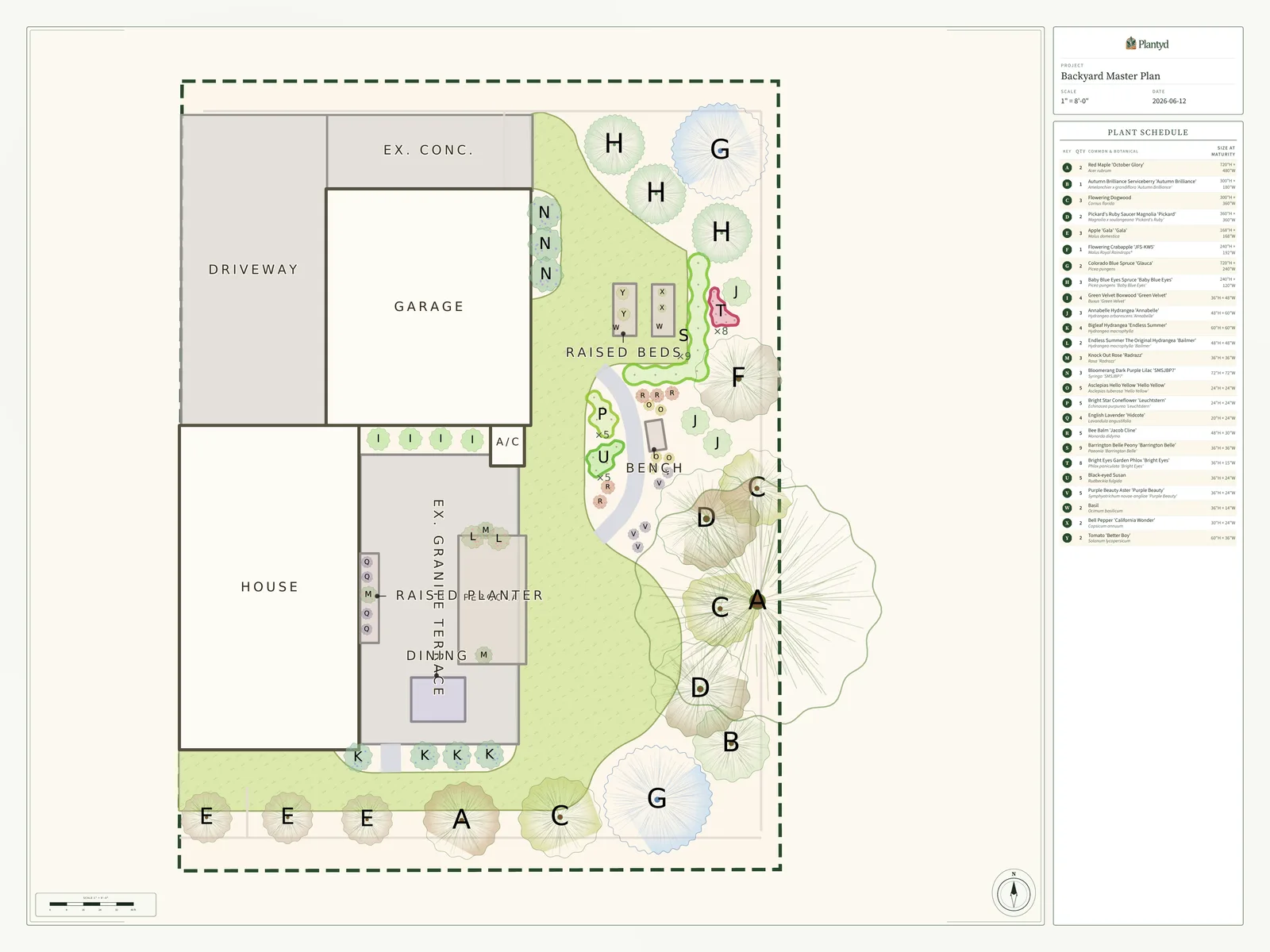
The yard is 89 by 117 feet in USDA zone 6a. Onto that quarter acre the plan fits 88 plants across 25 species: a butterfly garden with its own bench, two raised vegetable beds, a pergola-shaded terrace, a corner stand of five spruces, and a small apple orchard along the back fence. This is whole home landscape design in the plainest sense: one drawing that accounts for the entire property, even though nobody plants all of it in one weekend. Here's how it fits together, piece by piece, plus the four moves worth copying into your own plan.
Start with what's already there
Look closely at the plan and you'll see "EX." on several labels: the granite terrace, a concrete pad behind the garage, two gates. Those mark existing features, and they matter more than they look. A master plan is one drawing of where the whole yard ends up, even if the work takes five years, so that picture has to include what stays put. The terrace anchors the seating, the gates fix where paths begin, and every new bed is shaped around them.
This is worth copying even if you never hire a designer. Trace your house, driveway, and fences first. Decisions get easier when the immovable things are already on the page.
A butterfly garden you can sit in
The centerpiece is a curved stone path that leaves the terrace, bends past the raised beds, and puts a bench right in the middle of the planting. Around that bench the plan masses seven kinds of perennials: five 'Bright Star' coneflowers, five black-eyed Susans, eight 'Bright Eyes' garden phlox, five 'Jacob Cline' bee balm, five 'Hello Yellow' butterfly weed, five 'Purple Beauty' New England asters, and nine 'Barrington Belle' peonies wrapped around the vegetable beds.
The species list reads like a relay schedule. Peonies open in late spring. Bee balm, phlox, coneflower, black-eyed Susan, and butterfly weed carry the summer. The asters take over in September and hold until frost. Butterfly weed (Asclepias tuberosa) is the quiet star here: it's a milkweed, which makes it a host plant for monarch caterpillars, not just a nectar stop for the adults. The red bee balm pulls in hummingbirds too. Four of the seven are eastern North American natives.
Why the plan says ×8
When several plants of one species grow as a single drift, Plantyd outlines the group and labels it once, with a count. That's what the "×8" under the phlox means. It keeps a 25-species plan readable, and it nudges you toward planting in masses, which is how perennials look intentional instead of scattered.
Vegetables next door to the pollinators
Step off the path at the top of the bend and you're at two raised beds: two 'Better Boy' tomatoes, two 'California Wonder' bell peppers, and a pair of basil plants. A salsa garden, basically. Placing it against the butterfly garden is smarter than it looks. The beds sit on the route between bench and terrace, so the daily check on the tomatoes happens without a special trip, and all that bee traffic next door doesn't hurt the pepper harvest either.
An outdoor room with a planted edge
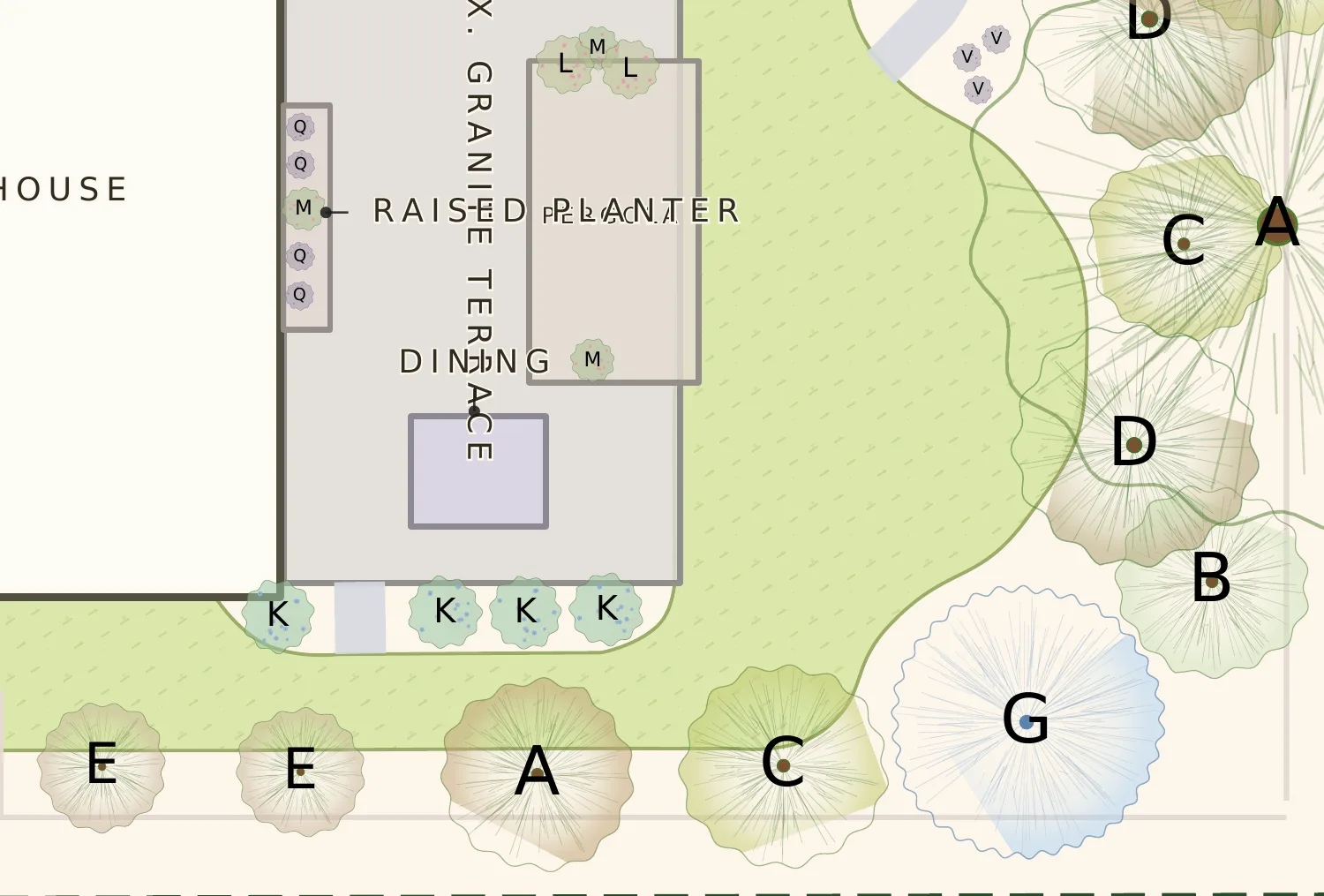
The granite terrace was already there. What the plan adds is furniture, in the horticultural sense. A pergola shades the dining end. The raised planter beside it holds two 'Endless Summer' hydrangeas and a Knock Out rose. A second, narrow planter runs along the house wall with four 'Hidcote' lavenders, so the scent sits right at elbow height next to the chairs. And where terrace meets lawn, a row of four bigleaf hydrangeas softens the line so the stone doesn't just stop.
Trees with assignments
Seventeen trees go into this plan, and each has a job. Three 'Gala' apples line up along the back fence. Galas set far more fruit with a cross-pollination partner, and the plan hides one in plain sight: the 'Royal Raindrops' crabapple near the bench. Crabapples are what commercial orchards plant as pollinators, and this one earns its spot twice over with pink spring bloom and purple foliage.
The far corner gets a screen of five spruces, but layered rather than lined up: three compact 'Baby Blue Eyes' spruces in front of two full-size Colorado blue spruces. The stagger reads like a grove instead of a wall. Down the east side, three flowering dogwoods, two 'Pickard's Ruby' saucer magnolias, a serviceberry, and two 'October Glory' red maples make a tree line with something happening in every season, from magnolia bloom in March to maple color in November. Closer to the house, three reblooming 'Bloomerang' lilacs greet you at the garage corner and four 'Green Velvet' boxwoods hide the air conditioner.
Seventeen trees also means seventeen shade footprints that will keep growing for decades. Before you commit to placements like these, it's worth mapping where that shade will land; our sun and shade analysis walkthrough shows how a garden's light map changes between year 1 and year 15.
Four moves worth copying
- Draw what exists before what's new. The "EX." labels are the skeleton of this plan. New beds are easy to move on a canvas; the terrace and gates are not.
- Give the path a destination. The bench sits in the middle of the butterfly garden, not at the end of the yard, and a path with somewhere to stop gets used.
- Buy five of one perennial instead of five different ones. Every perennial in this plan comes in a drift of five to nine, and that repetition is most of what separates designed from collected.
- Put the orchard's pollinator somewhere pretty. The crabapple pollinates the Galas from forty feet away while decorating the bench.
Like the zone 7a native garden in our sun and shade walkthrough, this plan was built entirely in Plantyd: beds traced, plants filtered to the zone, and the sheet above exported as a PDF you could hand to a contractor, or to the person at the nursery loading your trunk.
Common questions
What is a whole home landscape design?
One plan that covers the entire property: the house, driveway, and existing features, plus everything you intend to add, drawn together so each piece supports the others. Designers call it a master plan. The one in this post fits a butterfly garden, vegetable beds, a terrace, a privacy screen, and a small orchard onto a quarter acre, and it still works if the installation takes five years.
Should I design the whole yard at once or one area at a time?
Design it all at once, then install it in phases. Paths, trees, and sight lines cross from one area into another, so pieces designed separately rarely connect. In this plan, the crabapple that pollinates the apple row sits forty feet away in the butterfly garden. You only catch a connection like that when the whole yard is on one sheet. Build in whatever order the budget allows.
Can I draw a whole home landscape plan myself?
Yes. Start by tracing what already exists: the house, driveway, fences, gates, and any hardscape that's staying. Then place plants at their mature sizes, not the size they are at the nursery. In Plantyd you can trace beds over your actual lot, filter the plant catalog to your zone, and export the finished plan as a PDF a contractor or nursery can read.
How many plants does a whole yard plan need?
This quarter-acre plan uses 88 plants across 25 species, and most of that count comes from repetition: every perennial appears in a drift of five to nine, never as a single. Buying multiples of a few species reads as designed; buying one of everything reads as collected. Seventeen of the 88 are trees, each with a specific job like screening, fruit, or shade.
Sketch your backyard before you dig
Trace what's already there, place every plant at its mature size, and export a plan worth keeping. Free to start.
Start designing freeNo credit card required · Free tier is free forever